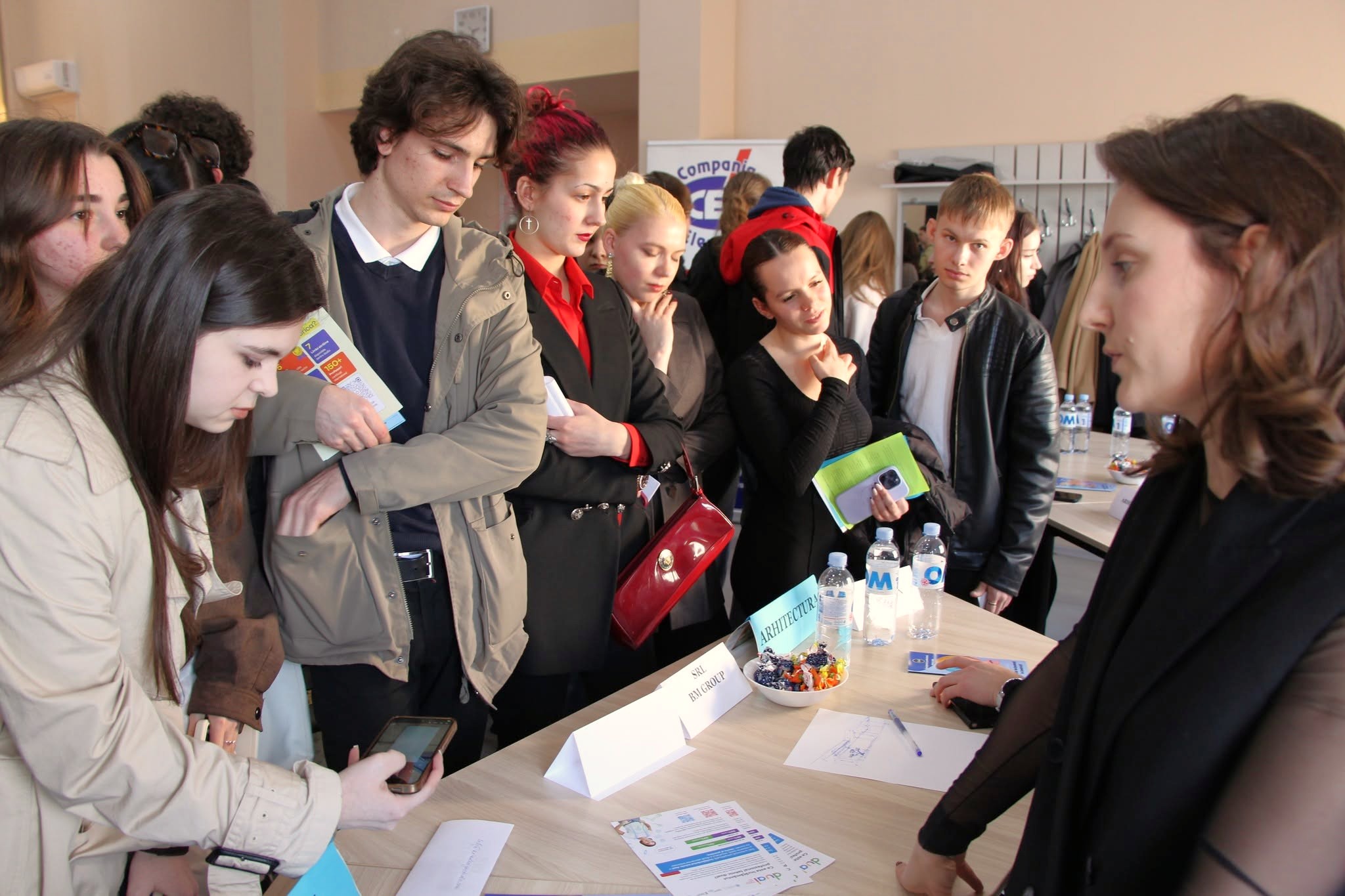
How can dual vocational education and training be strengthened in Moldova? How can we get more young people excited about vocational training and involve businesses more closely? The “Dual VET” project, supported by the Liechtenstein Development Service (LED), addresses precisely these issues. The results so far are promising. A study tour to Serbia and Switzerland also provided valuable insights for the further development of the vocational training system.
More Training Positions and Stronger Partnerships
The project aims to make dual vocational education and training in Moldova more attractive and to improve cooperation between vocational training institutions and companies. Significant progress has been made in this regard over the past few months.
Through informational events, company visits, career guidance, and a broad-based communication campaign, young people and their parents are informed about the opportunities offered by dual vocational training. Young ambassadors play a special role in this effort by sharing their own training experiences on social media. The videos released so far have garnered over three million views.
Cooperation between vocational training institutions and companies is also developing positively. Through funded programs, 18 new corporate partnerships have already been established.
Further results demonstrate the growing interest from the business community:
- 53 in-company trainers from 42 companies have completed continuing education in pedagogy.
- 229 companies have expressed interest in offering a total of 2,515 dual training positions for the 2026–2027 training year.
These developments lay the groundwork for better aligning vocational training with the labor market and opening up better career prospects for young people.
Learning from International Experiences
Another important step in the project was a study tour to Serbia and Switzerland. A delegation from Moldova, comprising representatives from the Ministry of Education, vocational schools, businesses, industry associations, the Chamber of Commerce and Industry, and development partners, learned about various models of vocational training networks.
Through exchanges with vocational training institutions, companies, and industry organizations, the participants gained insights into the organization and collaboration of training companies. This also included meetings with stakeholders in the Swiss vocational training system, the Department of Education of the Canton of Zurich, and the Vorarlberg Chamber of Commerce.
Particular attention was paid to the question of how apprenticeship networks can make it easier for small and medium-sized enterprises (SMEs) to get started with dual vocational training. This is because not every company has the personnel or financial resources to offer a full apprenticeship program on its own.
A key insight from the study tour: There is no one-size-fits-all model for successful training consortia. Rather, what matters most is which specific challenges need to be addressed. Training consortia can take on a variety of tasks, such as recruiting apprentices, coordinating training positions, sharing training infrastructure, or organizing practical placements across multiple companies.
International experiences offer valuable insights in this regard. However, these models cannot simply be applied to Moldova; they must be adapted to the local economic, legal, and institutional conditions. The findings are now being evaluated in collaboration with Moldovan partner organizations. The goal is to identify suitable approaches that will enable the long-term development of dual vocational training in Moldova.
The project demonstrates how important cooperation is between the government, vocational training institutions, and the business community. When training programs are tailored to the needs of the labor market and more companies participate in training, young people’s career prospects improve.
Through its support of the project, the LED is contributing to the further development of practice-oriented vocational training in Moldova. Special thanks go to the host organizations of the study tour: the Carpenters’ Apprenticeship Network, Jomb AG, AZW, the Zurich/Schaffhausen Builders’ Association, the Vorarlberg Chamber of Commerce, and the Zurich Cantonal Department of Education, as well as all other participating partners.