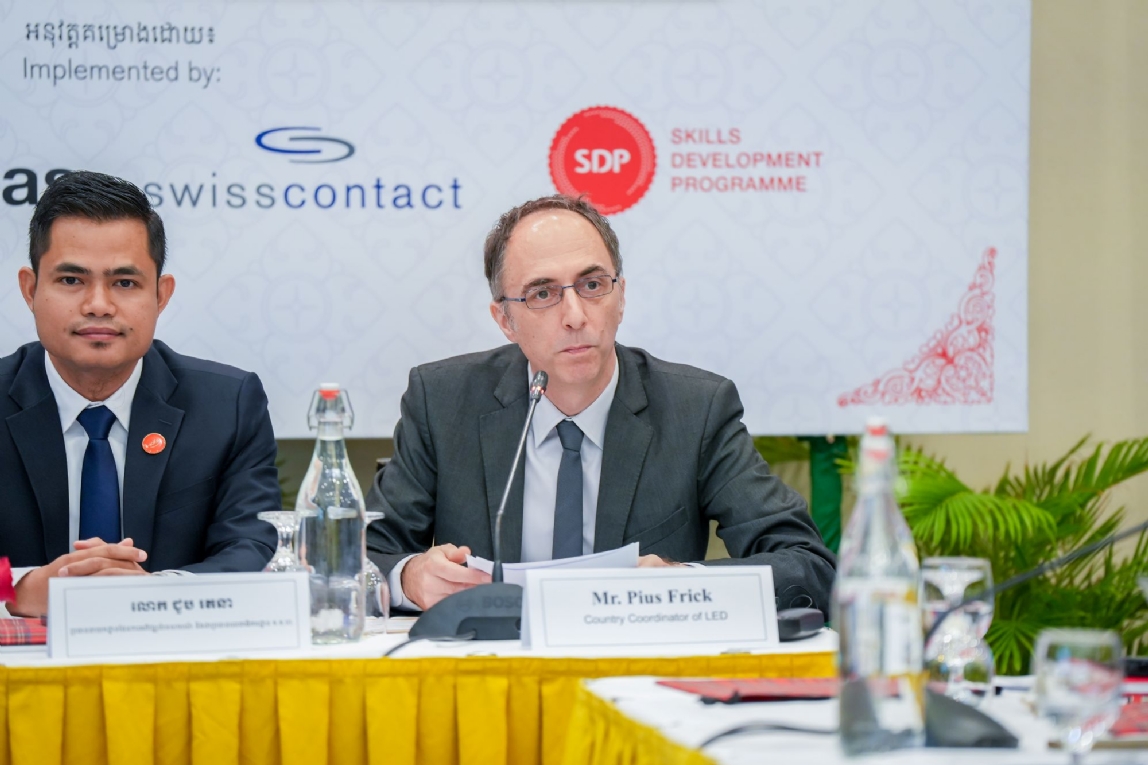
Pius Frick has been coordinating the country program of the Liechtenstein Development Service (LED) in Cambodia since March 2022. In this interview, he explains why targeted vocational training is crucial for young people, what Liechtenstein brings to the table – and how the work has a concrete impact on the ground.
Pius, what exactly is your task in Cambodia?
I manage the LED country office in Phnom Penh. Together with local partners, I am building up a portfolio of vocational training projects that is tailored to the needs of the country. The LED country program for Cambodia serves as my guideline. In consultation with the relevant ministries and business organizations and together with competent organizations, the aim is to develop projects that improve vocational education and training. This also involves regular exchanges with other donors and stakeholders in vocational education and training. A large part of my work is therefore coordination work.
Why is the focus on vocational training?
Because it is essential for the social and economic development of the country. The country has a very young population – the average age is around 26 years (in Liechtenstein this figure is 44 years). Every year, hundreds of thousands of young people reach working age. However, many of them have neither completed elementary school nor vocational training. The economy is heavily geared towards low-wage sectors. Qualified specialists are needed to diversify towards more value creation. The national development strategy therefore places great emphasis on education and vocational training.
In addition, the vocational training system is still relatively new. After the genocide and the long-lasting phase of insecurity caused by the Khmer Rouge associations that still exist, systematic vocational training only emerged from around the turn of the millennium. Like education, vocational training is still at an alarmingly low level. This cements existing inequalities. Children from economically disadvantaged families in particular tend to drop out of basic education at an early age and therefore have little access to vocational education and training. They therefore have little chance of breaking out of the vicious circle of poverty that spans generations. Anyone born into a poor family is likely to remain poor.
What do these inequalities look like?
There is a double divide: between urban and rural areas – and between the sexes. In cities, access to education, vocational training and digital infrastructure is better. But of course there are also disadvantaged and poor people in the cities. But in rural regions, the range of opportunities is generally not only lower but also of lower quality. Girls and young women are severely underrepresented in technical professions. In many places, technology and digitalization are still seen as a male preserve. However, digital skills are becoming increasingly important in the world of work. As a result, those who are already disadvantaged will find it even more difficult to get better jobs. Many end up as low-paid assembly line workers, often working in difficult conditions. There is work in Cambodia – but many jobs are just enough to survive, not to live a dignified life. In fact, a large proportion of people can be described as “working poor”. Although they are just above the statistical poverty line, they are part of the large mass of the vulnerable group.
What specific topics are you working on?
Our three focus areas are: Vocational training for the energy transition, for tourism and for the digital transformation. All of these areas are very dynamic and promising. It is also important to us to promote vocational training for professions that provide a decent income.
The energy sector is facing major challenges. The country’s electricity consumption has increased sevenfold in the last fifteen years. The government is endeavoring to oblige large companies to become more energy efficient and to increase the proportion of renewable energies. Skilled workers will be needed for a sustainable energy future. Tourism is the third-largest employer and also offers prospects for women – especially outside of urban centers, where jobs are scarcer. Digital skills are about enabling participation for everyone.
How does the will to change manifest itself on the ground?
A good example is the PISA study. Cambodia is one of the few countries in the Global South to have already taken part in the study twice. The country has the lowest scores of all participating countries in reading and writing, math and science. The results were sobering, but important. They show where the education system stands. The Minister of Education wants reforms. The Ministry of Labor is also willing to reform. That is a good prerequisite. But the challenges are huge, the resources are few and the number of experts is very limited.
How does the LED work on site?
I think it is important to understand that the LED does not simply finance projects that are presented to us. We are actively involved in the conceptual planning of the projects and ensure that they are in line with the objectives of the country’s sector strategies. We identify implementation partners who have the relevant expertise, experience and the necessary network. And, of course, we provide technical and administrative support during implementation. Due to their size alone, many donors have a certain distance to the projects they finance. The LED tries to stay close to the projects and build strategic partnerships.
This is also one of the principles of the LED Strategy 2023-2026: We want to achieve the greatest possible impact with the resources available by focusing and building up expertise. In doing so, we take into account the principles of equal opportunities, gender equality, environmental sustainability and ownership by the partner countries.
What does this work bring Liechtenstein?
It shows that even a small country like Liechtenstein can make a significant contribution – if it acts in a targeted manner, in partnership and with expertise. We are not only strengthening structures in Cambodia, but also Liechtenstein’s profile as a reliable, competent and committed partner in international development cooperation. As a donor, the LED is an interlocutor for government and business partners. This is visibility, which is much more important than the usual visibility within projects.
What motivates you personally?
The energy of young people. Her will to look forward and build a future despite adverse circumstances. Cooperation with committed partners, teachers and ministries. The work is not always easy – sometimes processes take a long time. But this is not only the case in Cambodia, but also here. As we often have time pressure in the projects, this can also be frustrating. But when movement occurs, it often happens quickly. Experiencing this is incredibly fulfilling.