On May 8, 2025, an exciting seminar on the future of development cooperation took place at the Capuchin monastery in Feldkirch. It was organized by the state of Vorarlberg in collaboration with the LED. Fortunately, many of the 18 participants were from Liechtenstein.
The seminar addressed current topics that are becoming increasingly important for development cooperation:
Decolonization: How do colonial structures continue to have an impact today? Why is it important to question power relations?
Impact measurement: How can the impact of projects be demonstrated? What standards need to be observed?
What does decolonization mean?
Decolonization means more than just the political independence of former colonies. It is about questioning old power relations, thought patterns and structures that still exist today. In development cooperation, this means that projects should not be planned and managed unilaterally by organizations in the Global North. Instead, partners in the Global South should have an equal say in what is needed and how projects are implemented. This reduces dependencies and strengthens local self-determination.
Why is the topic so topical?
The topic is gaining in importance because many partners in the Global South are increasingly pointing out that genuine cooperation only works if old ways of thinking are overcome. At the same time, donors are demanding more transparency and evidence that projects actually have an impact and are sustainable.
Impressions from the seminar
In the morning, Lawrence Oduro-Sarpong, live from Berlin, gave fascinating insights into the topic of decolonization. He encouraged the participants to rethink their own views and critically reflect on international cooperation. Questions such as: Who makes decisions? Who has access to resources? The discussion was lively and many gained new insights for their work.
Andrea Hoch from the Network for Development Cooperation, which unites around 40 civil society non-profit organizations with projects worldwide, draws the following conclusion: “The seminar impressively showed how deeply colonial patterns still have an impact today. It is important for aid organizations to take a closer look and make cooperation even more fair and based on partnership in the future.”
Impact measurement & quality standards
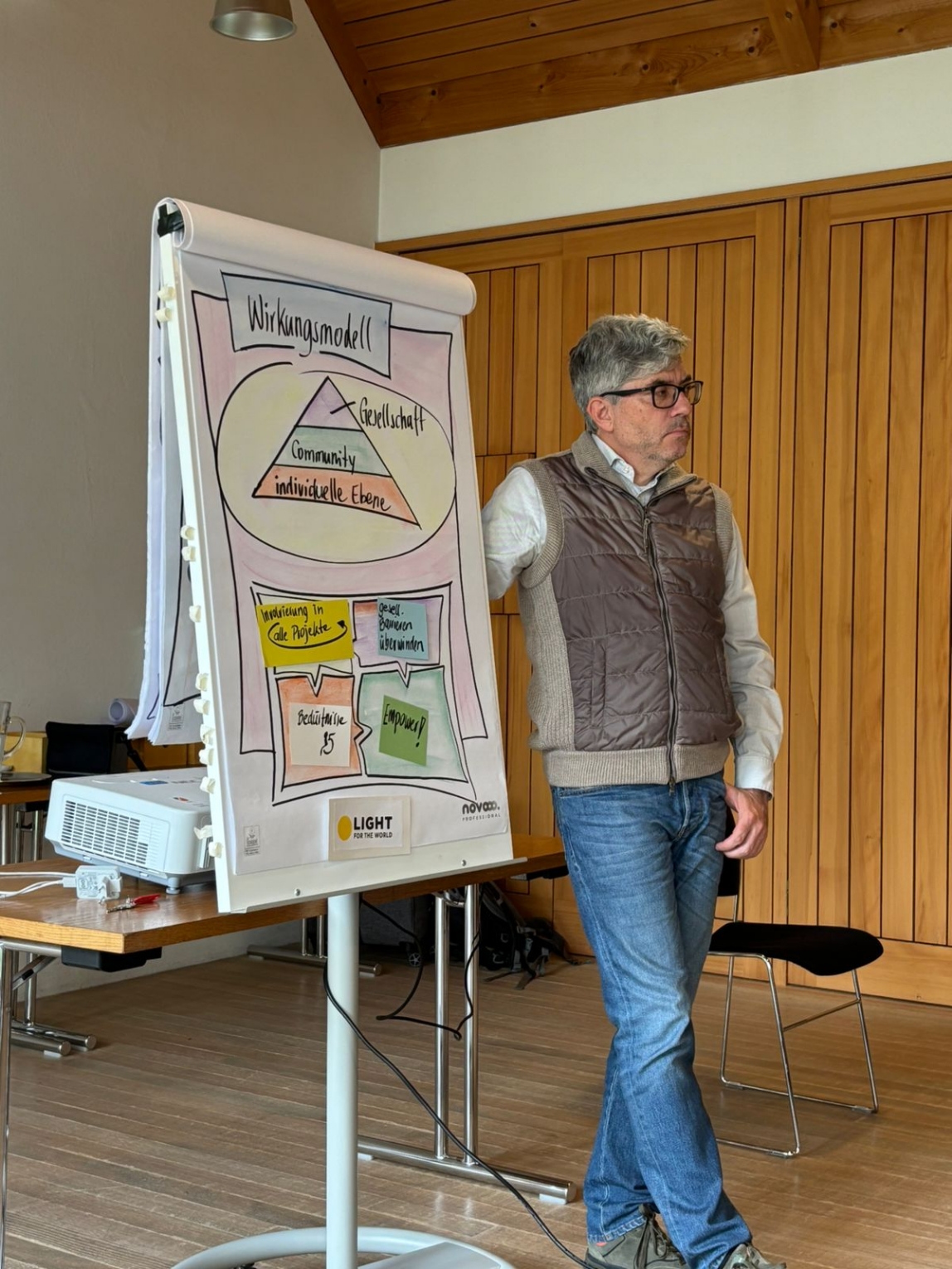
In the afternoon, Friedbert Ottacher demonstrated how important it is to make the impact of projects measurable. He presented simple models that help to make projects transparent and comprehensible. The role of quality standards and current developments in development cooperation were also discussed.
Maria Malin from the children’s aid organization Chance for Children in Ghana says: “For us as a local organization, it is particularly important that impact is not only measured from the outside, but that our experiences and perspectives are also taken into account. This seminar has given us a lot of valuable impetus for this.”
Outlook
The feedback was very positive: the seminar was perceived as exciting and enriching. Many participants wanted to explore these topics in greater depth in further workshops. We are currently looking into whether another seminar can be offered in the fall.
A big thank you to all participants for their great interest and open exchange. We look forward to the continuation!