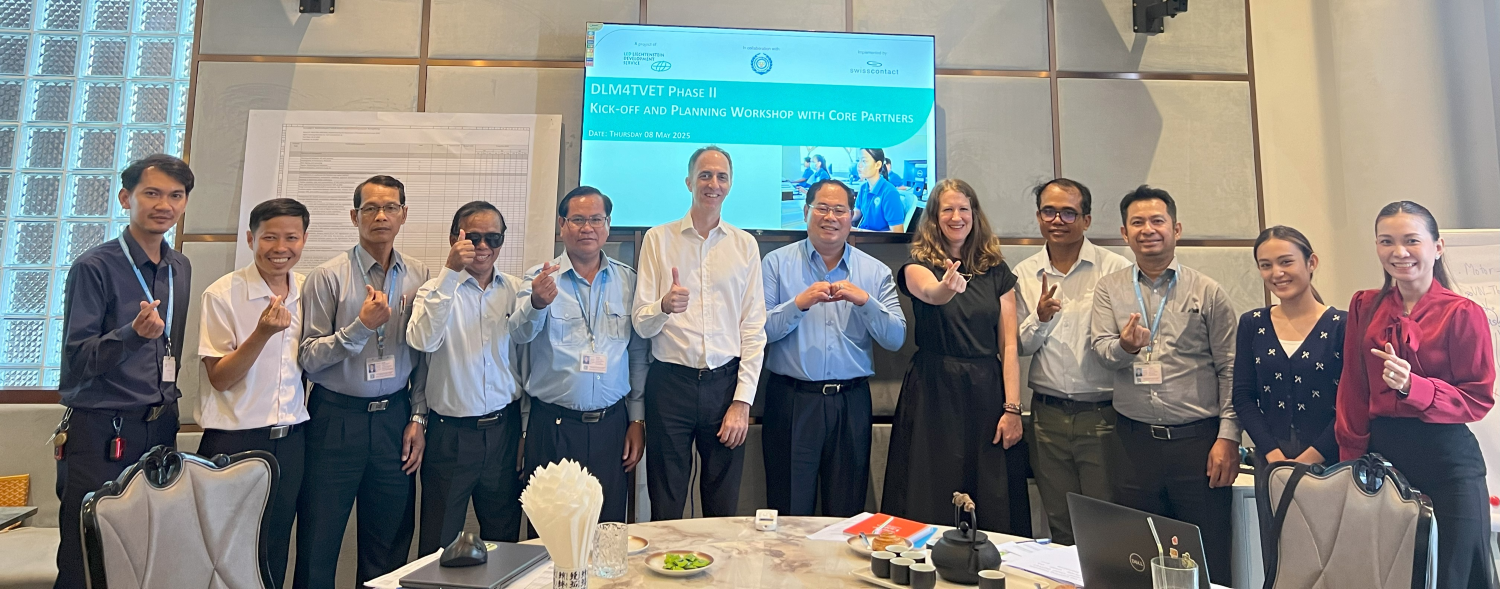
After four and a half years in Cambodia, Pius Frick is returning to Liechtenstein. As country coordinator for the Liechtenstein Development Service (LED), he established the organization’s presence in Cambodia and played a key role in shaping its collaboration with local authorities, vocational training institutions, and partner organizations. Today, the LED has an established country office, a well-developed network, and a clear focus for its work in the field of vocational training.
What began four years ago with the establishment of new structures and partnerships is now firmly established. The most recent milestone in this development was the signing of a memorandum of understanding with the Cambodian Ministry of Labor and Vocational Training on August 12, 2026. Labor Minister Heng Sour and Pius Frick signed the agreement in Phnom Penh. The memorandum strengthens long-term cooperation in the field of technical vocational education and training and complements the LED’s existing vocational training projects in Cambodia.
A key focus of the LED in Cambodia: Vocational Training for the Energy Transition
The LED-funded project “Solar PV Skills for Cambodia” is being implemented by WWF-Cambodia in collaboration with other specialized organizations. Over the first two years, experts from Solaire Sans Frontières, Don Bosco, and WWF will develop a hands-on training course in solar technology. Teachers from three vocational schools will receive intensive training so that they can successfully teach the course independently in the future. To do this, the schools also need the necessary equipment. In the long term, the goal is to establish a center of excellence for solar technology that can provide continuing education to teachers and specialists from vocational training institutions and companies. This will help embed the expertise in Cambodia’s vocational training institutions for the long term.
This project exemplifies the LED’s approach in Cambodia: Vocational training is intended to open up concrete employment opportunities for young people and help train skilled workers for the country’s economic and sustainable development.
Relationships and Structures That Endure
Setting up a country office goes far beyond individual projects. Over the past four years, the LED has built relationships with ministries, educational institutions, companies, and partner organizations and has continuously expanded its on-the-ground collaboration. “The years in Cambodia have been very instructive. We’ve built and achieved a great deal, but above all, I’ve learned just how important personal relationships, trust, and patience are in development cooperation. The fact that a strong local network now exists and that we can take the next steps together with our partners makes saying goodbye easier. I’m returning to Liechtenstein with many memories and a deep sense of gratitude, and with the certainty that the work here will continue,” says Pius Frick
Her successor will ensure that the work continues. With Leakhena Saroeurn, LED has gained an experienced Cambodian expert as deputy country coordinator. She brings more than ten years of experience in international development cooperation and has in-depth knowledge of project management, partnership development, and the systemic integration of projects. Other key areas of her work to date include gender equality, inclusive employment, and private sector development.
The past few months have been devoted to close collaboration and the handover process. At the same time, the new LED strategy and the Cambodia Country Program 2027–2030 are currently being developed. This marks the beginning of the next phase of LED’s work in Cambodia. After four and a half years, Pius Frick leaves behind not only a well-established country office, but above all, sustainable partnerships, a strong network, and structures upon which LED can continue to build. We sincerely thank Pius for his dedication and his work in establishing the LED’s presence in Cambodia, and we look forward to welcoming him back to Liechtenstein.